
Kalawao County SAVIN Coverage
Hawaiʻi SAVIN is the Hawaii Department of Corrections and Rehabilitation service delivered through VINELink. DCR identifies it as the public route for locating an offender. It provides custody and parole status for people under DCR jurisdiction. That makes it useful after a Kalawao-related arrest leads to admission at Maui Community Correctional Center or another DCR institution. An arrest by the Kalawao Sheriff, a deputized officer, or a National Park Service ranger does not by itself create a SAVIN record. The person must enter a participating custody system.
Kalawao has no conventional county jail, county inmate roster, or recent-release feed. MCCC is the likely DCR serving path for ordinary state custody connected to the Molokaʻi area, but the arresting agency and court control where a particular person goes. If police processing ended in a citation or release without DCR admission, the incident record and eCourt Kōkua may be more useful than VINELink. If DCR accepted the person, SAVIN can supply the first public status signal.
The official Hawaiʻi SAVIN page explains the state program and its registration channels.
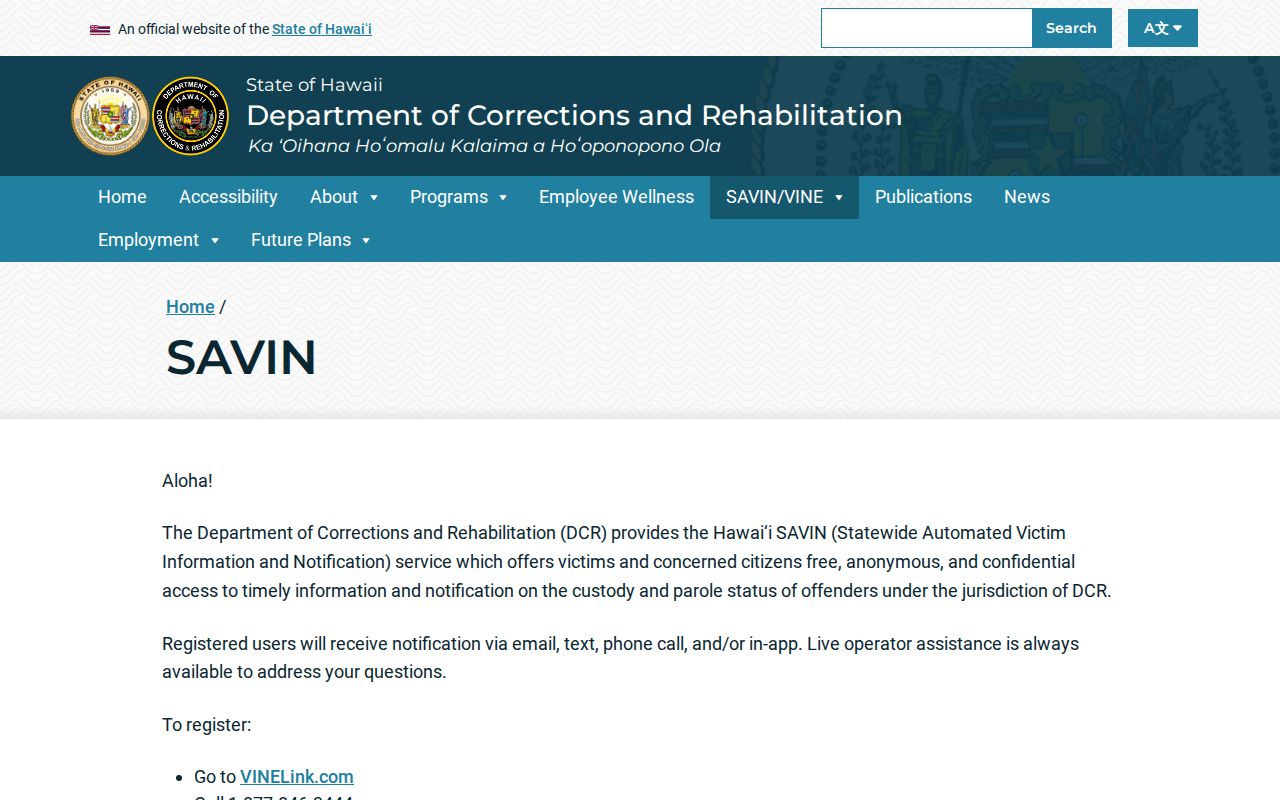
Searching and registering are separate actions. A person may check a record without creating an alert, while an ongoing notification requires its own registration steps.
Search Kalawao County VINELink
Begin with the last known custody type. Use VINELink for a person believed to be in Hawaii DCR custody or on Hawaii parole. Do not assume that every Kalawao arrest belongs there. Keep the full legal name, offender number, or case number ready. Two matching identifiers are safer than a name alone, especially when the name is common.
- Open VINELink and select Hawaii.
- Choose the offender or person search.
- Enter the full name and add an offender or case number when available.
- Compare identifiers and the reporting agency before opening a match.
- Read the exact custody or parole status and any dated event shown.
- Record the system name, search date, identifier, and status wording.
- Confirm a consequential release or transfer with the custodian or court.
The VINELink search begins with state selection and a person lookup.
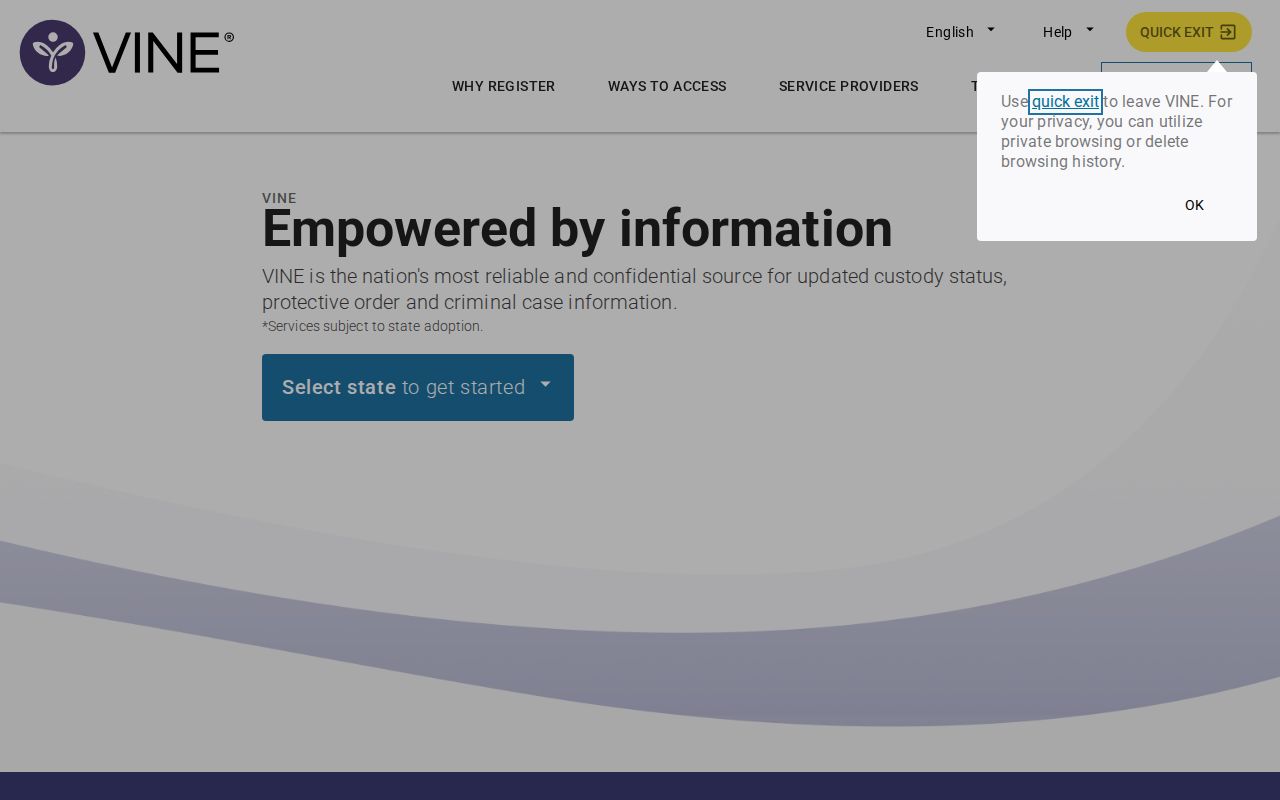
No match is not proof of release. A spelling difference, protected matter, transfer, interface aging, data delay, or custody in another system can produce an empty result. Change channels instead of converting absence into a fact.
Kalawao VINELink Release Fields
The vendor interface can change, so only the labels visible in the live record should be quoted. DCR and its brochure support status details and event notifications. They do not support a promise that every record permanently displays a photograph, complete sentence history, or projected date.
| Item | What it can establish |
|---|---|
| Name and identifier | Helps distinguish the correct person from similar names. |
| Reporting agency or facility | Identifies the system supplying the status, when displayed. |
| Custody status | Shows the current wording reported by the participating agency. |
| Parole status | May indicate a DCR person is under Hawaii parole supervision. |
| Status date or event | Dates the reported change where the interface provides it. |
| Notification option | Allows registration for configured custody or parole events. |
Released, discharged, and out-of-custody wording should not be treated as interchangeable unless the result uses that exact term. “Out of custody” can mean only that the reporting agency no longer holds the person. A transfer to another DCR institution, another state, ICE, or federal custody is not community release. The court file explains legal authority; DCR or the receiving agency confirms where custody went.
Register Kalawao Release Alerts
Notification registration can deliver later changes without repeated manual searches. Hawaiʻi SAVIN supports phone, text, email, in-app, and TTY routes. The official brochure recommends using more than one method. Choose channels that are safe and regularly checked. Registration is confidential, but the account information and PIN still deserve careful handling.
- Open the correct person record and choose notifications, or call 1-877-846-3444.
- Select phone, text, email, in-app, or TTY delivery.
- Enter the requested contact information and complete current verification prompts.
- For telephone alerts, create a four-digit PIN.
- Enter that PIN when VINE calls to acknowledge the message.
- Keep the person’s identifier and PIN secure.
- Update contact details if a number or address changes.
TTY registration is available at 1-866-847-1298. The Hawaii SAVIN office can route service questions at 808-587-1356. An alert is a prompt to verify, not a certified release record or a complete personal-safety plan. If the alert conflicts with the live record, contact SAVIN and the holding facility.
Why Kalawao Uses Hawaiʻi SAVIN
Kalawao’s distinctive problem is the split between arrest authority and custody. The county’s special administration includes a Kalawao Sheriff and deputized officers, while federal rangers also operate within Kalaupapa National Historical Park. None of that creates a Kalawao corrections database. Hawaii DCR operates the state jail system, and MCCC is the defensible serving facility when ordinary state custody is established. SAVIN follows the DCR layer rather than the county boundary.
This wider custody and parole coverage is more useful here than a single-jail roster would be. It can continue to report a person who moves within DCR or enters parole status. Yet it cannot explain every stage before DCR admission. For a person who vanished after local police contact, first ask which agency accepted custody. Search SAVIN only after DCR becomes a plausible custodian. This distinction prevents a fruitless hunt for a nonexistent Kalawao County Jail entry.
MCCC’s role must also be stated with care. It is a state community correctional center on Maui, not a Kalawao County facility. DCR has described it as serving Maui County, including Molokaʻi and Lānaʻi, which makes it the likely receiving path in an ordinary state case from the area. Still, a federal case, another DCR placement, or release at the police-processing stage can produce a different route. The reported agency field and the arrest or transfer record should settle the path for the identified person.
Confirm Kalawao County Release
DCR warns against relying solely on SAVIN because data can be incomplete or delayed. Confirmation should pair sources that control different facts. eCourt Kōkua can show whether a First Circuit judge entered bail, dismissal, sentence, probation, or another release-related order. MCCC or DCR controls whether a DCR release or transfer was completed. Hawaii Paroling Authority controls a parole decision. A narrow UIPA request creates the durable fallback when a public interface no longer retains the person.
For a sentenced federal prisoner, use the BOP Inmate Locator. A pending federal detainee may require the federal court and USMS channels. Immigration custody belongs in the ICE locator. The Covered Offender Registry applies only to qualifying convictions and is not a general release database. A full custody-type decision path and records-request fallback appears on the Kalawao County released inmates search.
When a DCR result reports release, ask whether the person entered the community, moved onto parole or furlough, or transferred. If the answer remains unclear, request releasable records sufficient to show the effective custody-end date, releasing facility, release category, and whether another agency took custody. Exclude protected medical, victim, juvenile, and security details and invite segregation of releasable portions.
For a mismatch, contact the office that owns the disputed fact. SAVIN staff can address service and notification problems. The facility controls whether it completed a release or transfer. A court clerk can provide the public order, while HPA controls its parole action. Keep the exact status text rather than paraphrasing it into a broader claim. A result that proves departure from one agency should remain limited to that agency until the next custodian is checked.