
Kalawao Projected Date Limits
Hawaii DCR does not publish a public projected-release-date profile for Kalawao County cases. VINELink reports custody or parole status and supports notifications. Exact dates require the sentence record and confirmation from DCR or the Hawaii Paroling Authority. This matters because Kalawao has no conventional county jail, no county roster, and no local sentence calculator.
A pretrial detainee generally lacks a sentence-based release date. Bail, supervised release, dismissal, trial, or another court action controls that custody episode. Someone serving a short jail sentence has a court term and may receive credit for qualifying time already spent in custody. An indeterminate felony sentence works differently: the court fixes the maximum term, HPA sets the minimum, and DCR computes credit and custody time.
Find Kalawao Release Timing
Start by identifying whether the person is at Maui Community Correctional Center, another Hawaii DCR institution, a federal facility, or an immigration facility. MCCC is the defensible DCR serving path for ordinary state custody linked to the Molokaʻi area, but not every Kalawao arrest goes there. Arrest authority, court jurisdiction, and final custody can belong to different agencies.
- Obtain the judgment and sentence from eCourt Kōkua or the court clerk.
- List every case, warrant, detainer, and hold that may affect custody.
- Confirm the sentence start, concurrency or consecutiveness, and qualifying presentence credit.
- For an indeterminate felony, obtain the HPA minimum-term order and latest parole action.
- Ask the holding facility or DCR Offender Management Office for the current computation.
- Distinguish parole eligibility from an approved and completed release.
- Recheck Hawaiʻi SAVIN near the expected event and confirm any change.
The Hawaii Judiciary online-records instructions explain how to reach eCourt Kōkua and other court access channels.
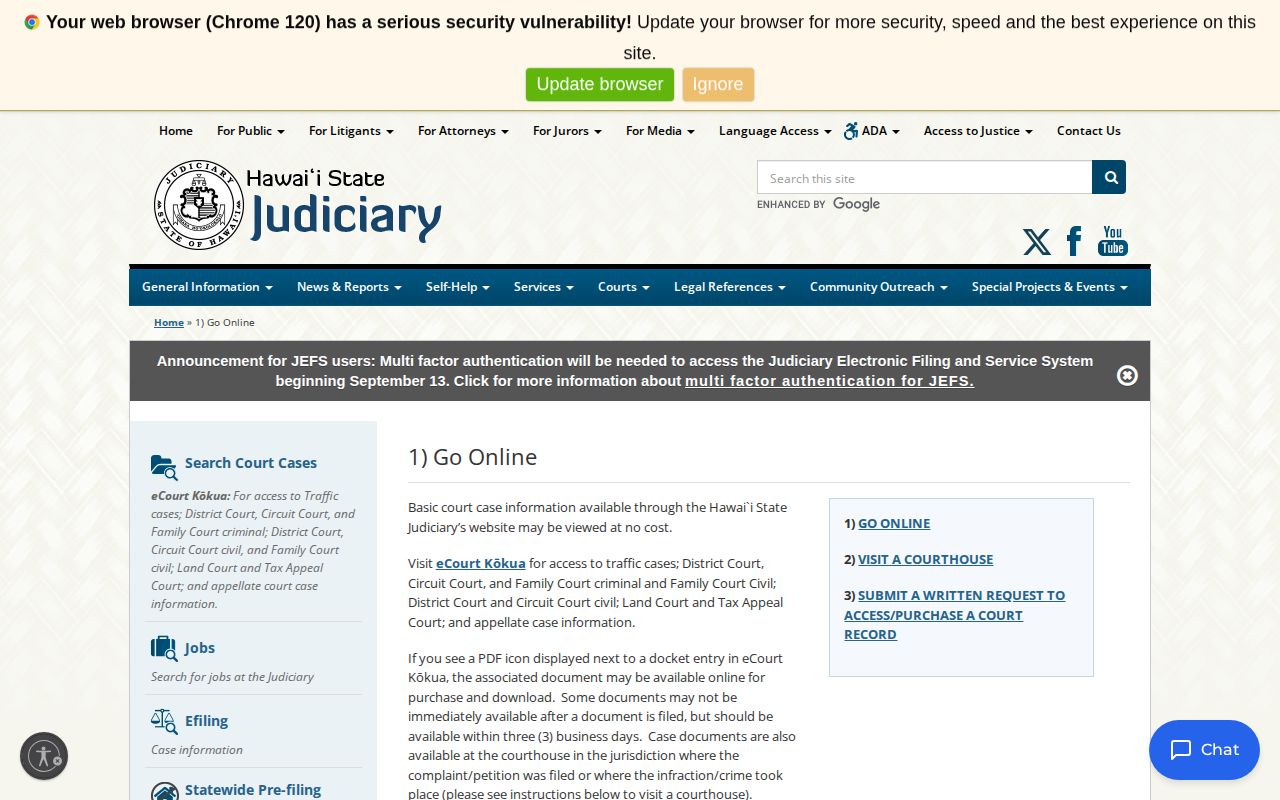
Kalawao belongs to the First Circuit despite its Molokaʻi geography. Confirm that assignment from the case itself and do not substitute a neighboring island’s court route without evidence. A docket entry can prove an order was entered, but DCR still controls whether it completed a release or transfer.
Kalawao Jail Sentence Dates
A short jail sentence begins with the court’s exact terms. Read the effective date, whether multiple terms run at the same time or one after another, and any credit awarded for detention before sentencing. Concurrent terms run together. Consecutive terms run in sequence. A “time served” disposition may satisfy the sentence through prior custody, yet staff must still process the order and check other legal holds.
HRS §706-671 provides credit against minimum and maximum imprisonment terms for qualifying prior detention. DCR policy COR.05.05 says related time in police custody, DCR facilities, or other facilities may be included and that staff transmit presentence-credit information to HPA for sentenced felons. Presentence credit is not good time. It recognizes qualifying detention already served.
For an MCCC custody episode, ask DCR to confirm the current computation rather than counting calendar days alone. A clerical correction, another sentence, a warrant, or a detainer can change the practical departure. DCR’s release procedure also requires staff to verify the person, authority, other charges, and holds before release. An active hold can lead to transfer rather than entry into the community.
Kalawao Felony Minimum Terms
Hawaii uses indeterminate sentencing for many felony cases. Under HRS §706-669, the court sets the maximum imprisonment term while HPA fixes the minimum period that must be served before parole eligibility. That minimum is not a promised exit date. It marks the point at which parole can be considered under the governing sentence and board process.
HRS §706-670 requires an initial parole hearing at least one month before the minimum expires. If parole is denied, later hearings occur at intervals of twelve months or less until parole or maximum expiration. A grant can still depend on an approved release plan, sponsor or program, and administrative completion. Rescission can intervene before departure if new information or plan problems require board action. The newest order controls over an old anticipated date.
The Hawaii Paroling Authority publishes its official materials and contact route.
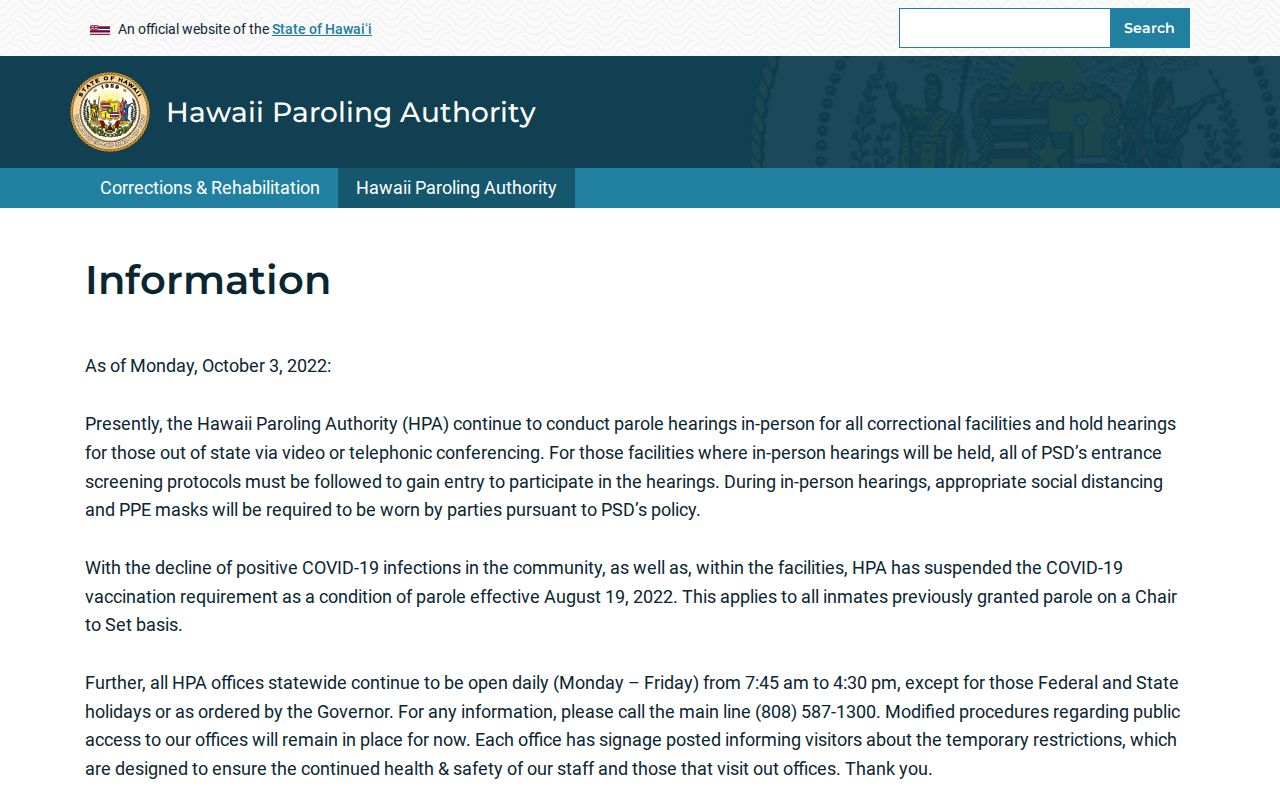
If HPA fixes no earlier release date, the maximum term provides the mandatory-release framework, subject to lawful custody on another matter. Probation is separate. It is imposed by a court as a community sentence and does not supply the prison minimum-term date.
Kalawao Release Computation Rules
Hawaii’s release computation is not a generic percentage subtraction. No general current law requiring every Hawaii prisoner to serve 85 percent was found in the research. A 2008 bill proposed such a rule, but a proposal is not enacted law. It must not be used in a calculator or presented as a current formula.
Nor does Hawaii publish a simple earned-time table that can be applied to every sentence. HPA may consider a reduction of minimum term under its rules, and credits or early discharge can be case-specific. The safe record path uses the actual judgment, the HPA minimum-term order, verified presentence credit, the DCR computation, and the latest hold information. An unsourced calculator result should never be published as a projected date.
The DCR corrections overview identifies the Offender Management Office’s sentence-computation role and routes the public toward SAVIN.
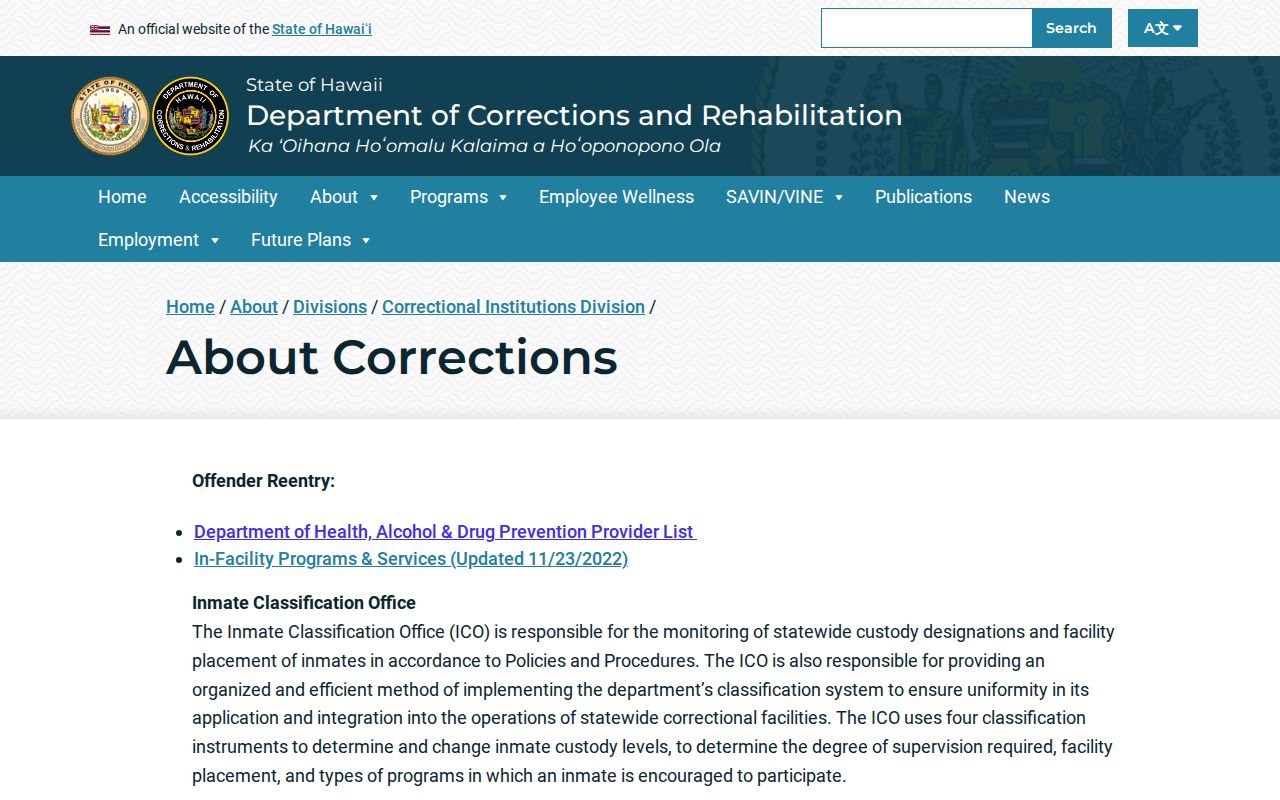
A focused inquiry should name the person, DCR or case identifier, facility, sentence, and approximate dates. Ask for the current computation or releasable records sufficient to show it. DCR may protect detailed internal material, but a narrow question is more useful than a demand for the whole inmate file.
What Changes Kalawao Release Dates
A date can move because different legal and operational facts enter the calculation. The reason determines which office can resolve the discrepancy.
| Factor | Effect and confirmation source |
|---|---|
| Presentence credit | Qualifying prior detention reduces time remaining; verify through the judgment and DCR computation. |
| Concurrent or consecutive terms | Terms may overlap or run in sequence; read the sentence for every case. |
| Corrected court order | An amended judgment can alter the computation; use the newest filed order. |
| HPA action | A grant, denial, reduction, deferral, or rescission affects parole timing; obtain the latest HPA action. |
| Release plan | A grant may await an approved sponsor or program before physical departure. |
| Warrant, detainer, or hold | Another agency can prevent community release or take custody; confirm with that agency. |
| Other sentence or case | One completed term does not end lawful custody on another matter. |
Transfer language deserves special care. Leaving MCCC for a state prison, federal authority, or immigration detention ends one facility’s custody but not confinement. Use “transferred” until the receiving system confirms its status. A person can also leave incarceration on parole or furlough while remaining under legal conditions, which differs from final unconditional discharge.
No Kalawao 85 Percent Shortcut
The local computation angle follows directly from Hawaii’s division of authority. The court fixes the maximum and sentence terms. HPA sets the minimum for an indeterminate felony. DCR applies presentence credit and maintains the custody computation. Those pieces cannot be replaced by a single statewide percentage, and parole eligibility cannot be renamed as guaranteed release.
This distinction is especially important in Kalawao because there is no county corrections office to supply a local projected-date screen. The statewide records must be reconciled. Ask which date is being quoted: sentence end, minimum-term expiration, parole hearing, approved parole date, maximum expiration, or a facility’s anticipated processing date. Each answers a different question.
Confirm Kalawao Release Date
Near the anticipated event, check Hawaiʻi SAVIN for the current custody or parole status, then contact the facility or responsible office for a discrepancy. The Kalawao County VINELink inmate search explains the person-match and alert process. SAVIN is a fast status signal, not a certified computation or release document.
For an old event or a person who no longer appears, pair the court judgment with a focused DCR UIPA request. Ask for the effective release date, releasing facility, legal authority or category, and whether the person entered the community or transferred. For a federal sentence, use the BOP locator and federal record channels. For possible ICE custody, use ICE separately. No one system proves another agency’s status.
The strongest result combines the institution that authorized the event with the custodian that completed it. Preserve the exact wording and date from each source. If they conflict, ask the office responsible for that field to correct or explain it instead of choosing the most convenient number.