
Kalawao County Parole and Probation
Parole is conditional release from prison. The Hawaii Paroling Authority, or HPA, sets minimum terms for indeterminate felony sentences and decides whether parole should be granted. A parolee has left physical confinement but remains under HPA legal custody and control. Probation is different. A judge imposes it as part of the sentence, and the Hawaii Judiciary supervises it through its adult client services system.
Neither label proves that a case ended. A parole grant may depend on an approved plan and final processing. A probation order can later be modified, revoked, or discharged. Use the exact status shown by the agency that controls it.
| Point | Parole | Probation |
|---|---|---|
| Who orders it | Hawaii Paroling Authority after a prison sentence | The sentencing court |
| Who supervises it | HPA field services | Hawaii Judiciary adult client services |
| First public check | Hawaiʻi SAVIN, then HPA | eCourt Kōkua, then First Circuit |
| How it ends | Final release or maximum-term expiration | Court discharge or completion |
Check Kalawao County Parole Status
Hawaii DCR does not offer a separate public offender-profile database. Its official locate-an-offender route is Hawaiʻi SAVIN, delivered through VINELink. SAVIN covers custody and parole status for people under DCR jurisdiction. It is useful only after a Kalawao-related person enters DCR custody, such as at Maui Community Correctional Center. An arrest by a Kalawao sheriff or park ranger alone does not create a DCR record.
- Search VINELink after selecting Hawaii and enter the full legal name.
- Add an offender or case number when the interface permits.
- Compare at least two identifiers and check the reporting agency.
- Read the exact custody or parole label and status date displayed.
- Call HPA at 808-587-1300 for the public way to confirm active supervision and office assignment.
- If the result conflicts with the court or facility record, ask the agency that owns the disputed fact.
A search result is a status signal, not a certified discharge record. SAVIN warns users not to rely on it alone. An old parole hearing also proves little by itself. The board may deny or defer release, require a plan, rescind a grant before departure, or later return a parolee to custody.
The Kalawao County released inmate search explains how to pair SAVIN with the actual custodian and court record when the question is physical release rather than supervision.
Note: Match a common name with an offender or case number before attributing a parole status.
Verify Kalawao County Probation Records
Probation starts with the judgment. Search the Hawaii Judiciary’s online court-record access, then review eCourt Kōkua entries in date order. A public docket may show judgment, sentence, a probation order, later modification, revocation, or discharge. Some reports and personal details remain protected, so the public docket may not describe every condition.
Kalawao has an unusual route. Although it lies on Molokaʻi, HRS §603-1 places the District of Kalawao in the First Circuit. The defensible first contact is the First Circuit Adult Client Services Branch at 808-539-4500. Ask staff to confirm the precise unit before relying on an office assignment. Do not route the case to Second Circuit probation merely because nearby Molokaʻi communities use Molokai District Court.
Kalawao Supervision Contacts
Hawaii Paroling Authority
1177 Alakea Street, First Floor
Honolulu, HI 96813
808-587-1300
First Circuit Adult Client Services Branch
808-539-4500
Confirm the assigned probation unit through the Judiciary directory.
Kalawao County Parole Hearing Records
HPA’s public materials explain several events that are easy to confuse. A minimum-term hearing sets the period that must be served before eligibility. An administrative review may assess institutional progress. A parole hearing considers conditional community release. Later proceedings can address rescission before release, or revocation after a parolee returns on an alleged violation.
Under HRS §706-670, an initial parole hearing occurs at least one month before minimum-term expiration. If parole is denied, further hearings occur at intervals of twelve months or less. Those timing rules do not create an automatic release. A result marked granted still needs proof that the plan was approved and the person actually left custody.
The official HPA page publishes guidance, forms, reports, and notices, but the research found no stable name-search decisions database. For one person, use the written HPA order where lawfully available, SAVIN’s parole status, and a focused inquiry. Preserve words such as granted, denied, deferred, rescinded, or revoked because each has a different effect.
The official HPA contact page shown below is the source for board information and current routing.
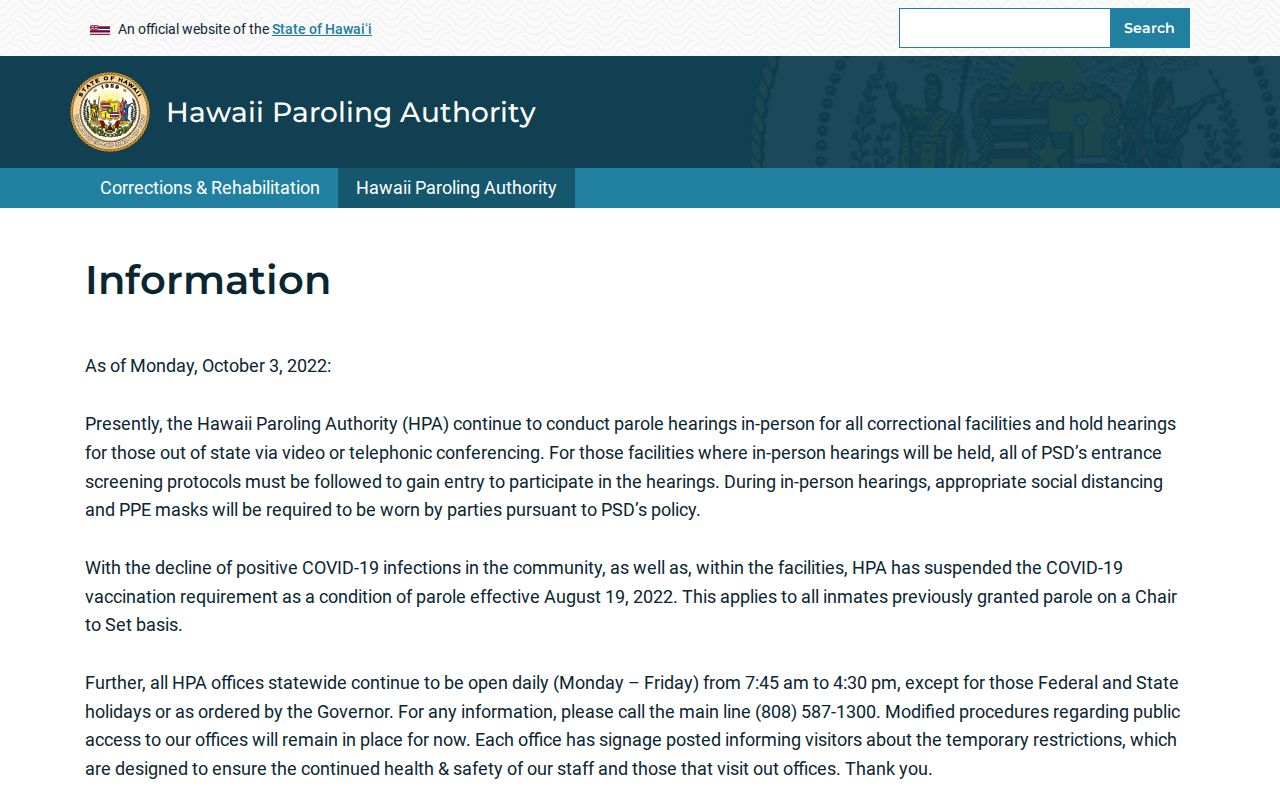
The page supports direct confirmation with HPA when a hearing document and live supervision status do not match.
Kalawao County Parole Warrants
An absconder or warrant status does not mean a person is still incarcerated. It means the supervising authority alleges that the person cannot be located or has not complied, and arrest may be sought. No Kalawao-specific public absconder list was found. Rumor and social posts are not substitutes for an official record.
Check the newest court docket, contact HPA for parole, and use authorized warrant channels. A parole warrant may return a person to custody, but it does not prove that final revocation has occurred. HPA’s process can include preliminary or probable-cause steps before a revocation hearing. The outcome may restore parole or continue confinement.
Property After Kalawao County Release
DCR’s release procedure adds a practical check to supervision records. It requires staff to verify identity, collect state-issued items, return personal items and money on release or as soon as practical, and update Offendertrak at once. That update supports SAVIN’s custody and parole information. A person who sees an error should contact the releasing facility and the SAVIN office, then use a written records request when a durable correction trail is needed.
For a release from Maui Community Correctional Center, property questions go to 808-243-5102. That line is for property routing, not disclosure of another person’s status. Public release confirmation belongs with DCR, the facility’s approved channel, or a UIPA request. Keep the custody episode, date, identifier, and claimed error in the request.
Note: A returned wallet or account balance does not establish that parole supervision has ended.
When Kalawao County Supervision Ends
Release from a cell and release from legal supervision are not the same event. A parolee remains supervised until HPA supports final unconditional release or the controlling sentence reaches its lawful end. A probationer remains subject to the court’s order until completion, discharge, or another court action changes the sentence.
Use the agency tied to the status. HPA controls its parole decision. The Judiciary controls the probation order. DCR controls whether a DCR custody release or transfer occurred. If a person left MCCC for another prison or agency, supervision in the community did not begin merely because MCCC stopped holding the person. Ask for the exact end status and date, not a broad case history.
A focused written request can seek the releasable document that shows discharge or the end of the custody relationship. Protected reports may be withheld or redacted. The public record should still be read with its source, date, and exact wording intact.