
Kalawao Release Paths Differ
Kalawao is a jurisdictional exception. The Department of Health operational table assigns local law enforcement to the Kalawao County Sheriff and deputized officers. National Park Service rangers and dispatch also work in the park, and Maui County provides mutual aid. None of those facts creates a Kalawao County jail. Arrest authority describes who may take a person into custody. It does not identify the agency that later books, confines, transfers, or releases that person.
The likely ordinary state custody path leads through Maui Community Correctional Center, a Hawaii Department of Corrections and Rehabilitation facility on Maui. This is a researched serving-custody path, not a claim that every Kalawao arrest goes there. The actual arresting or transporting agency, commitment order, and DCR record control. A federal charge instead requires the federal path through the U.S. Marshals Service and, where applicable, Federal Detention Center, Honolulu.
The agency split is the key to avoiding a search for a jail or roster that does not exist.
What Kalawao Release Means
“Released” answers what happened to one custody episode. It does not necessarily mean the criminal case ended. A person may leave pretrial detention on bail, bond, recognizance, supervised release, or dismissal. A short sentence may end through time served or sentence expiration. A sentenced person may enter parole or furlough. Another person may leave MCCC only because DCR transferred custody to a prison, a federal agency, immigration authorities, or another jurisdiction.
| Record wording | What it may mean | What still needs checking |
|---|---|---|
| Bail, bond, or recognizance | Physical pretrial custody ended | The case and release conditions may continue |
| Time served | The ordered jail term was satisfied | Other cases, warrants, or holds |
| Parole or furlough | Community transition with continuing legal control | HPA status and approved release plan |
| Transfer | The first facility stopped holding the person | The new custodian; this is not community release |
| Discharged or maximum expiration | The stated sentence relationship ended | Any separate custody matter |
A court order proves that legal authority was entered. The custodian’s record proves whether staff completed a release or transfer. Those facts should be paired. A released status in one system also does not rule out custody in another.
Kalawao Release Record Fields
A narrow Kalawao County release record should identify the person and the custody episode without demanding protected correctional material. DCR policy supports the operational role of identity checks, release authority, warrants, detainers, property, bail documents, victim notification, Offendertrak updates, SAVIN, approved programs, and transfers. Some detailed release documentation is confidential, so disclosure depends on Hawaii law and agency redaction.
| Requested field | Why it matters |
|---|---|
| Full name and identifier | Separates people with similar names |
| Admission or booking episode | Ties the answer to the correct period of custody |
| Releasing facility | Identifies the custodian responsible for completion |
| Effective date and time | Shows when the custody event took effect |
| Legal authority or category | Distinguishes bond, sentence end, parole, and other bases |
| Destination category | Separates community release from transfer |
| Hold status | Explains why one order may not cause physical release |
The public record may not contain every internal field. Medical, victim, juvenile, institutional-security, and other protected information should not be requested as part of a basic release confirmation.
Request Kalawao Release Records
Hawaii’s Uniform Information Practices Act, Chapter 92F, governs access to state and county government records. For a DCR custody episode, send a focused request to DCR. For a Kalawao Sheriff or Department of Law Enforcement arrest, booking, transfer, or agency-held photograph, use the DLE UIPA request instructions and its request form. Ask the agency to segregate and release public portions if part of a record is protected.
- Identify the person with a full legal name and any known DCR, SAVIN, report, or case number.
- Give an approximate arrest, admission, or release date and name the likely facility.
- Ask for the effective custody-end date, releasing facility, release category, and whether custody transferred.
- Choose a practical format and ask for a cost estimate before copies are made.
- Keep the request and response so later status errors can be traced.
The Office of Information Practices fee guidance explains that search, review, copying, mailing, and vendor charges can differ. No fixed amount should be assumed. The agency’s current estimate controls.
A release request should seek the end of one custody episode, not a complete confidential corrections file.
Kalawao Records and Expungement
There is no sourced Kalawao retention period for a public release interface. A person’s disappearance from VINELink does not prove when release occurred. For an older event, the court docket and a focused custodian request are more durable than a live status screen. Chapter 92F access remains subject to privacy, law-enforcement, juvenile, sealing, expungement, and other limits.
Hawaii Criminal Justice Data Center explains the current expungement process. Qualifying expunged arrest records become confidential. For orders granted from July 1, 2025, HCJDC automatically sends the order to the Judiciary for consideration of removal from the public electronic database. Expungement does not justify rebuilding an old photo or arrest trail from commercial caches.
The official expungement page shows the application route and present handling rules.
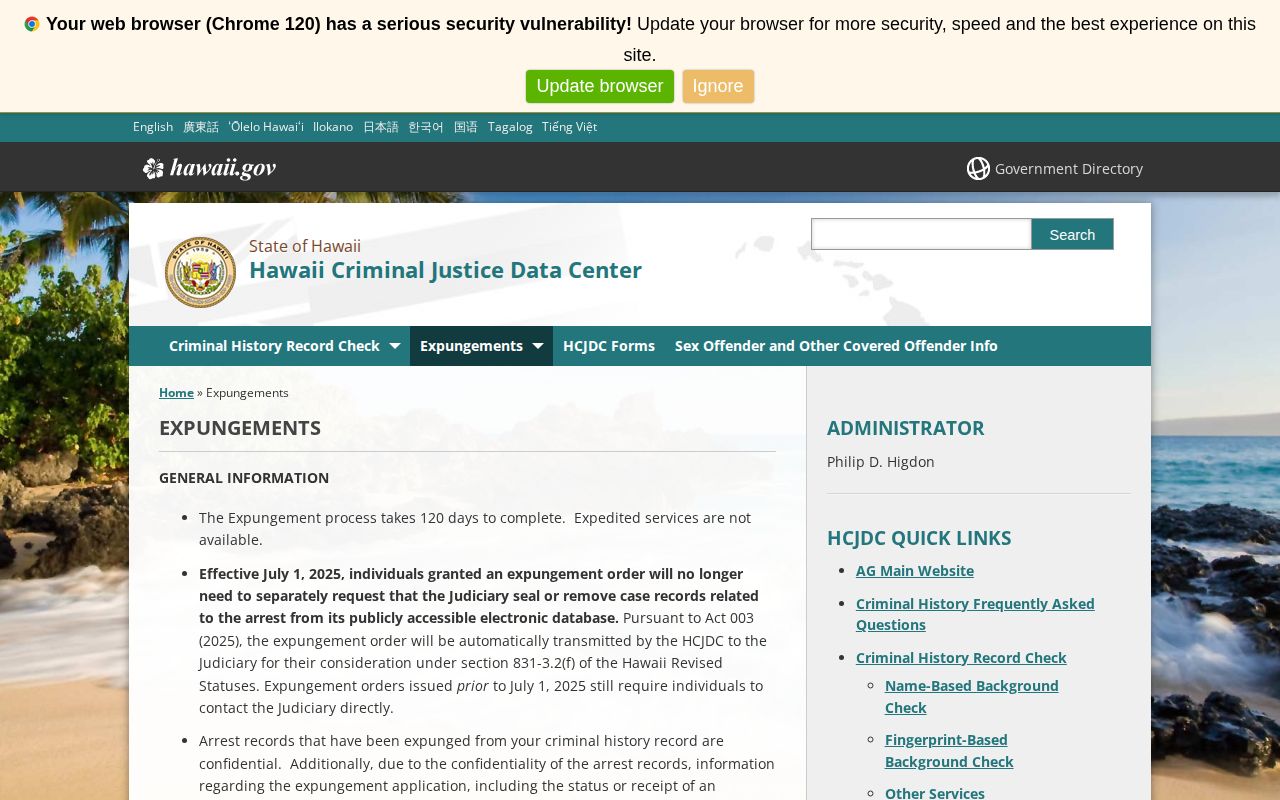
The agency and court control confidentiality. Third-party copies may be stale or wrong.
Search Kalawao Released Inmates
The best search follows the person across agencies. Start with the last known custodian, not the place of arrest. Hawaii DCR uses Hawaiʻi SAVIN through VINELink as its public “Locate an Offender” route. It reports custody and parole status and can notify a registered user of configured events. It is not a certified release record or a permanent county ledger.
- Search VINELink, select Hawaii, and use the exact name plus an offender or case number where available.
- Compare identifiers and the reporting agency before treating a result as a match.
- If MCCC appears, contact the facility and ask which public channel confirms community release versus transfer.
- Search Hawaii Judiciary court records for the order, judgment, sentence, or disposition.
- Use HPA for parole, a focused UIPA request for an older DCR event, and the appropriate federal system when custody changed.
An empty result can reflect spelling, aging, transfer, a protected case, or delay. “Not found” is a reason to change channels. It is not proof that the person was freed.
The Hawaii VINELink search screen is the public DCR status starting point.
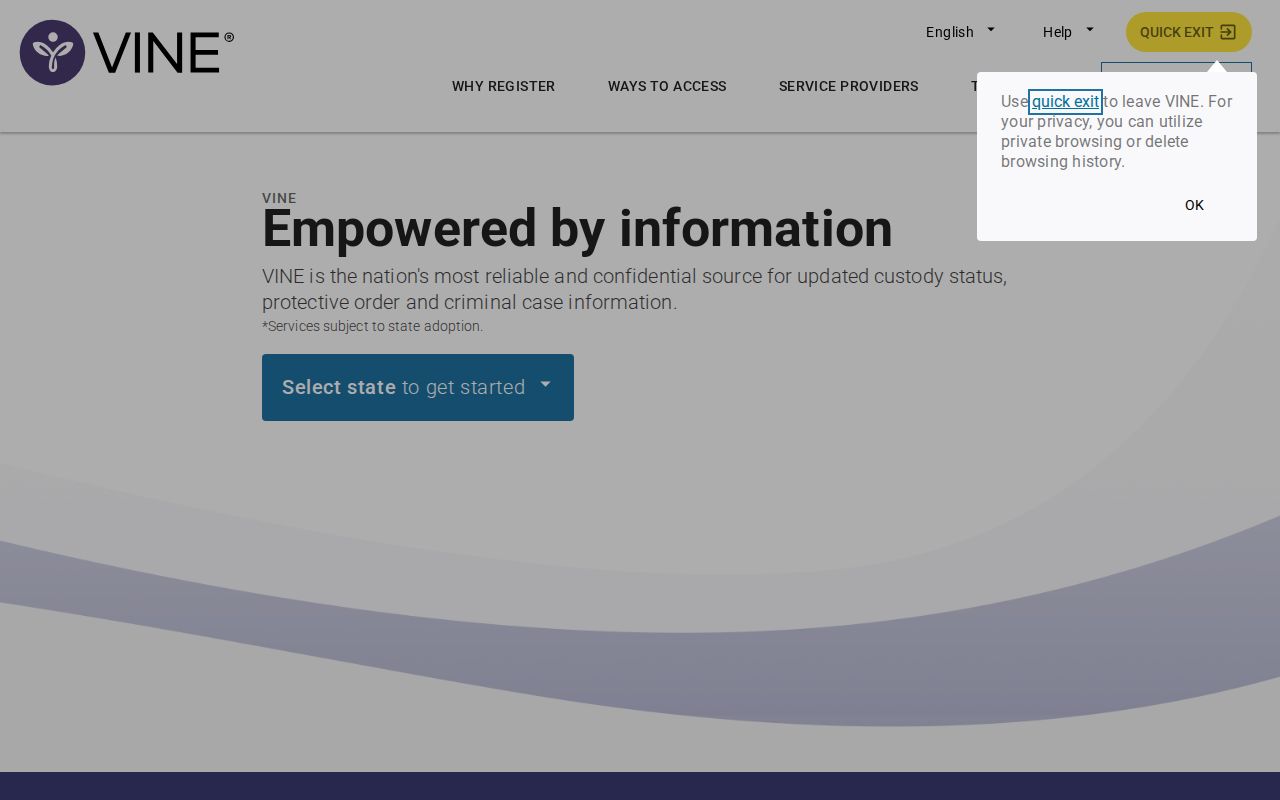
Always preserve the exact status wording, date checked, reporting agency, and identifier.
Kalawao Court Release Records
Kalawao’s court route is statewide, not a stand-alone county database. Although Kalawao lies on Molokaʻi, HRS §603-1 places the District of Kalawao in the First Circuit. Do not substitute a neighboring Molokaʻi court contact without checking the actual case. eCourt Kōkua may show a case number, party, charge, docket event, disposition, judgment, sentence, bail order, or document image, depending on coverage and access.
The Judiciary’s online-record instructions explain which systems cover each case type.
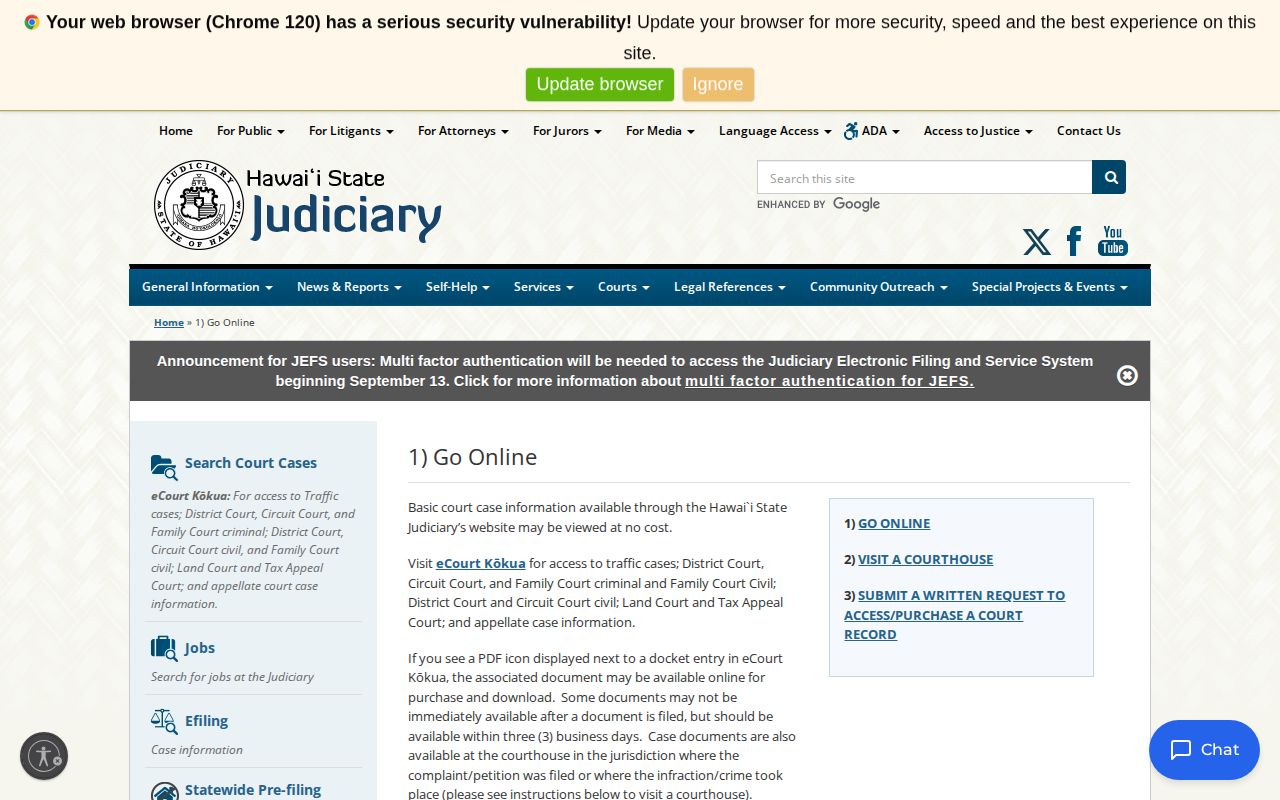
A docketed release order establishes legal authority. Pair it with DCR or SAVIN confirmation to show that physical release was completed.
Parole and Probation Status
Parole and probation are different. The Hawaii Paroling Authority sets minimum terms and controls adult parole after a prison term. Probation is imposed by a court and supervised through the Judiciary. A person on either status may live in the community, but parole remains a form of legal custody and control. A past hearing does not prove current supervision or physical release.
For parole, check SAVIN’s parole-status function and contact the Hawaii Paroling Authority. For probation, read the sentence and later entries in the court docket. Because Kalawao belongs to the First Circuit for this purpose, begin with First Circuit Adult Client Services and confirm the exact assigned unit. The full verification path appears on the Probation & Parole page.
DCR release procedure also requires an approved sponsor or program where supervised release calls for one. Property and money must be returned on release or as soon as practical, state items collected, identity verified, and Offendertrak updated at once. Errors should be raised with the facility or SAVIN office, followed by a written request when a durable correction trail is needed.
Transfers and Immigration Holds
An active warrant, detainer, or hold can prevent community release. DCR’s release procedure requires staff to check those barriers and not release a person subject to a hold unless it is rescinded or the requesting agency accepts custody. No Kalawao ICE contract facility was found. That absence does not prevent an immigration transfer from another custodian.
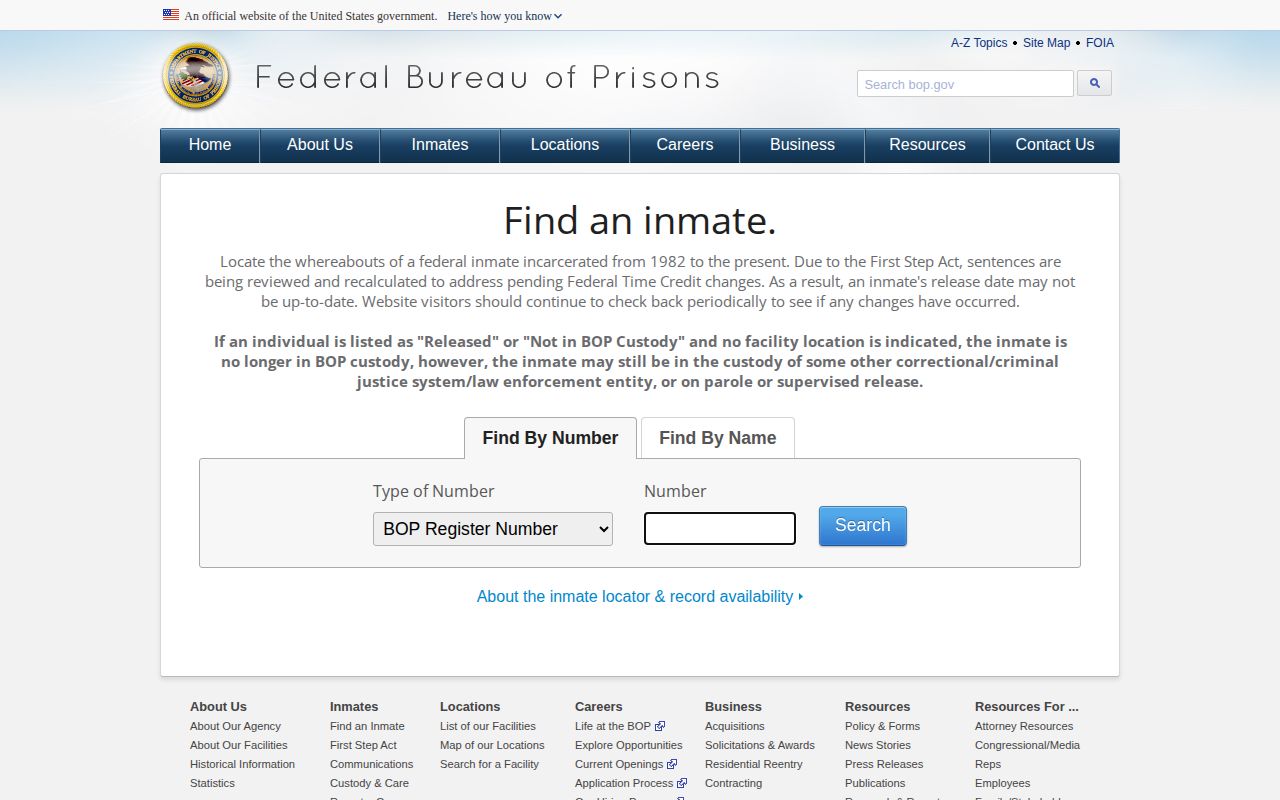
Use the ICE Online Detainee Locator only for immigration custody. Use the BOP Inmate Locator for federal Bureau of Prisons history. The U.S. Marshals Service may control pretrial federal placement. A record that says “released from DCR” or “not in BOP custody” speaks only for that agency.
The federal locator can display a historical release date or a not-in-custody result.
Check state, federal, and immigration systems separately when a transfer or hold is plausible.
Kalawao Custody Will Change
Kalawao remains a separate county under special Department of Health administration as of July 16, 2026. Act 171, Session Laws of Hawaii 2026, establishes a future statutory trigger tied to the last Kalaupapa Registry patient. The transition has not yet occurred. When DOH announces that trigger, law-enforcement and records routing may change.
Until then, the sound path remains agency-specific: the Kalawao Sheriff or another arresting officer for the initial event, DCR and MCCC for state confinement, the First Circuit record for court authority, HPA for parole, and federal agencies for federal or immigration custody. Current contact details should be rechecked after any DOH transition notice.
Confirm Kalawao Release Status
The strongest result combines sources that control different facts. A court order shows what a judge authorized. DCR shows whether its facility completed release or transfer. HPA controls its parole decision. BOP and ICE control only their own systems. Match records with at least two stable identifiers and preserve the exact wording. When sources conflict, contact the agency responsible for the disputed field and request a written record.
- Release
- The end of a specific confinement episode, sometimes with conditions.
- Discharge
- An end to the stated custody or supervision relationship.
- Detainer
- A request that a custodian hold or transfer a person for another authority.
- Parole
- Conditional community release while HPA legal control continues.
- Expungement
- A legal process that makes qualifying arrest information confidential.
For recent events, compare SAVIN, the actual facility, and the court. For old events, use the court record and a narrow UIPA request. That method reflects Kalawao’s unusual structure and avoids treating absence from a live interface as proof.
A careful result also names its limit. State whether the evidence proves a court order, a DCR status change, a transfer, parole supervision, or confirmed community release. That precision matters in Kalawao because several agencies may touch one case.
Match Kalawao Release Records
A reliable match needs more than a familiar name. Start with the full legal name, then compare an offender, register, report, or case number. Date of birth or age can provide a second check where it is lawfully available. A photograph alone is weak evidence, especially when the image is old or lacks a clear source. Record the system searched, the search date, the reporting agency, the identifier, and the status exactly as displayed. Those details let a later reviewer reproduce the search and spot an interface change.
When records disagree, rank each agency by the fact it owns. The court controls whether it entered an order. DCR controls whether a DCR facility carried out a release or transfer. HPA controls its parole action. BOP controls federal Bureau of Prisons status, and ICE controls immigration detention. A discrepancy should be sent to the office responsible for that field. Until the conflict is resolved, use qualified wording and do not convert an uncertain status into a claim of community release.
Older Kalawao Release Events
A live status service is designed for current information, not as a permanent historical archive. For a custody episode from years ago, gather the case docket first. The judgment, sentence, bail order, dismissal, or other disposition establishes the legal context. Then ask the custodian for the effective end date and destination category. Include aliases, the relevant case or agency number, an approximate date range, and the possible facility. This focused approach reduces mistaken matches and gives the custodian a clear record set to search.
Short police processing can also explain why no DCR result exists. If a person was cited or released before admission to a DCR facility, the arresting agency’s incident record and the court docket may be the only useful channels. Conversely, a person who disappeared from an MCCC result may have transferred, aged out of the interface, or been affected by a data correction. The record request should ask what ended the specific episode, not assume the answer in advance.